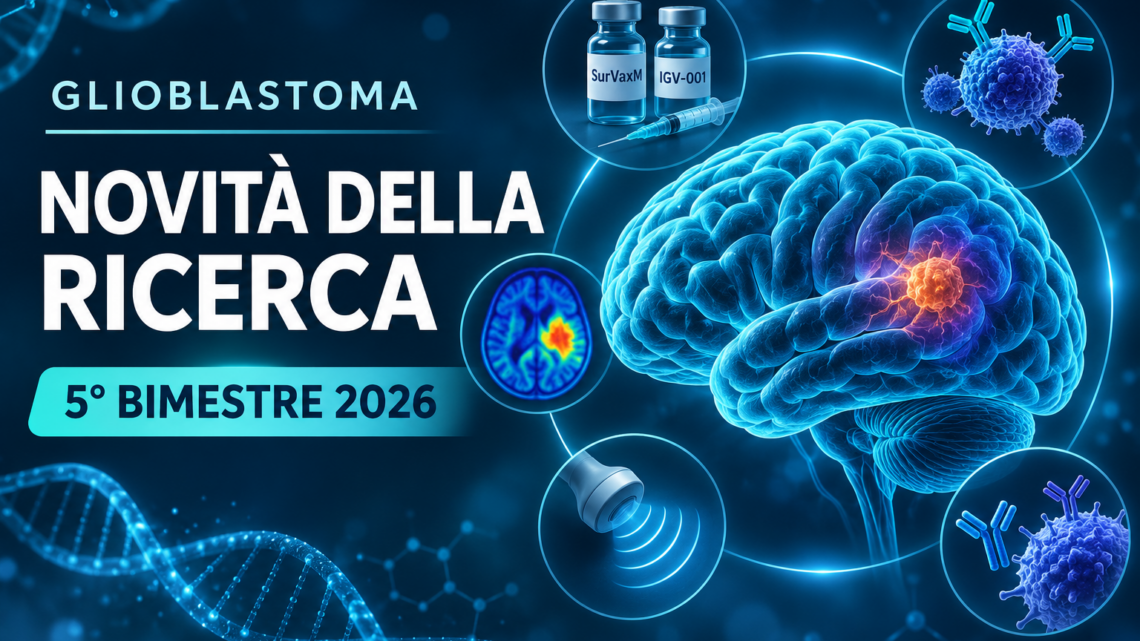
Research News for the Fifth Two Months of 2026
This is the thirty-ninth article of the project whose aim is to periodically collect (every two months) the research news on possible treatments for glioblastoma multiforme. Below I list the news items we considered most significant that emerged over the last two months. As with the previous articles in the series, each news item will be preceded by the original title with a link to the source and followed by a brief comment. The criterion by which the news is selected is always to include, in general, only news relating to research in the clinical phase, unless the research’s potential for the treatment of glioblastoma is truly remarkable.
MimiVax and Roswell Park Announce Results from Phase 2b SURVIVE Trial of SurVaxM in Newly Diagnosed Glioblastoma
SurVaxM is a peptide vaccine that trains the immune system to recognize survivin, a protein that helps tumor cells survive and is present in the vast majority of glioblastomas. The SURVIVE study (NCT05163080) is a randomized, double-blind, placebo-controlled phase 2b trial, conducted at 11 US centers in patients with newly diagnosed glioblastoma in good general condition, with minimal residual tumor after surgery and no progression at the end of standard chemoradiation. Among 233 evaluable patients, median overall survival was 22.8 months with SurVaxM versus 20.3 months with placebo: a 2.5-month difference that did not reach statistical significance, so the primary endpoint in the overall population was not met. The most interesting finding concerns the prespecified subgroup of patients aged 65 and under, where the difference was significant (24.2 versus 20.2 months), with 42% of treated patients still alive at 30 months versus 18% in the placebo group. The vaccine was well tolerated, with side effects mostly mild and at the injection site. It must be said honestly that a result in a subgroup, however prespecified, is not the same as a positive trial; it should also be noted that the placebo group lived longer than the expected historical benchmark, making the comparison more difficult. The company intends to discuss the results with the FDA: the most likely path is that further confirmation will be needed.
Imvax Announces Additional Data from Phase 2b Clinical Trial of IGV-001 in Newly Diagnosed GBM and Provides Update on Planned Clinical Development
IGV-001 is a personalized immunotherapy obtained from the patient’s own tumor cells, collected during surgery, treated with an antisense oligonucleotide and enclosed in small biodiffusion chambers that are temporarily implanted in the abdomen to stimulate an immune response against many tumor antigens at once. The phase 2b study (NCT04485949), randomized and placebo-controlled in 99 patients with newly diagnosed glioblastoma, had not met its primary endpoint; however, a prespecified analysis in the 48 patients with an unmethylated MGMT promoter — the subgroup that benefits least from temozolomide and has the worst prognosis — showed a median survival of 14.8 months versus 10.6 with placebo, a difference at the borderline of statistical significance, together with a slower functional decline and a favorable safety profile. Based on these data and after discussion with the FDA, Imvax is preparing a randomized phase 3 study of about 375 MGMT-unmethylated patients, with a start planned for 2027 subject to securing funding. It is a signal that needs confirmation, but it is aimed precisely at the population with the most urgent clinical need; the full data will be presented at the SNO congress in November.
Neoadjuvant PD1 plus CTLA-4 immune checkpoint blockade in surgically resectable recurrent glioblastoma: a randomized surgical window-of-opportunity trial
Published in Nature Communications, this randomized study (NCT04606316, coordinated by the Dana-Farber Cancer Institute) evaluated, in patients with operable recurrent glioblastoma, the administration of immunotherapy before surgery, with three arms: the combination of nivolumab (anti-PD-1) and ipilimumab (anti-CTLA-4), nivolumab alone, or placebo. The “window-of-opportunity” design makes it possible to analyze the removed tumor tissue directly to understand what the immunotherapy actually did in the tumor. The dual blockade markedly increased the infiltration of immune cells into the tumor and the measurable immune activation in the blood, and was associated with a median survival of about 13 months versus about 9 with nivolumab alone; greater immune infiltration and early signs of activation were linked to longer survival. Glioblastoma has so far been largely resistant to immunotherapy with checkpoint inhibitors used alone, and a previous confirmation study with a single neoadjuvant anti-PD-1 agent had shown no benefit. These results indicate that the combination can indeed “switch on” the immune response in the tumor; the numbers and design, however, are not enough to prove a survival benefit, which will have to be verified in dedicated studies.
EGFR-targeted antibody-toxin conjugate in recurrent glioma: a phase 1 trial
Published in Nature Medicine, this phase 1 study from Duke University (NCT02303678) evaluated D2C7, an immunotoxin made of an antibody fragment that recognizes both the normal form of EGFR and the tumor variant EGFRvIII, linked to a modified bacterial toxin that kills the cells it binds to. The drug is infused directly into the tumor through a catheter using convection-enhanced delivery, which bypasses the blood–brain barrier. Among 72 patients with recurrent glioblastoma, median survival was 7.9 months, with mild to moderate side effects, and some exploratory analyses identified biomarkers associated with longer survival. The result as a single agent is therefore modest, as might be expected from a study designed to establish safety and dosing. The most promising part is the subsequent development: Duke is testing D2C7 together with 2141-V11, an antibody that stimulates the immune system through the CD40 receptor (NCT04547777), and preliminary data presented at a congress on 27 recurrent patients indicate a median survival of 16.4 months, with no serious related adverse events. The numbers are still small and uncontrolled, but the idea of killing tumor cells while at the same time awakening immunity against them deserves attention.
Phase I trial of IL13Rα2-targeted CAR-T cell therapy for recurrent malignant glioma
Published in Clinical Cancer Research, this Korean phase 1 study (the MAGIC-I study, NCT05540873, National Cancer Center in Goyang) tested CAR-T cells directed against IL13Rα2, a receptor highly expressed in malignant gliomas and absent from healthy brain tissue, in patients with grade 3–4 glioma recurring after standard therapies. Its distinctive feature is the route of administration: a single intravenous infusion, much less invasive than the intracranial infusion used in most CAR-T studies in glioblastoma. Ten patients received three increasing doses without serious toxicity; the most common effects were fever and elevated liver enzymes. The CAR-T cells peaked in the blood after about a week and were also detected in the cerebrospinal fluid at the higher doses, a sign that they can reach the central nervous system. The signals of efficacy, however, are still limited: no tumor shrinkage, stable disease in three patients, median progression-free survival of about 2.6 months and overall survival of 10.9 months. It is a first step that demonstrates the feasibility and safety of the intravenous approach; a phase 2 study is planned, likely with strategies to boost the cells’ activity.
FDA Approves Telix’s Brain Cancer Imaging Drug Pixclara
We include a news item that concerns not a therapy but diagnostics, for its practical impact. In mid-September the FDA approved Pixclara, the first tracer for PET with FET (fluoroethyl-tyrosine, a labeled amino acid) available in the United States for gliomas, in adults and children from one month of age. FET-PET helps resolve one of the most difficult problems in managing glioblastoma: distinguishing true tumor progression from changes caused by treatment (such as pseudoprogression or radionecrosis), which can look very similar on MRI. It should be noted that for European readers the novelty is relative: in Europe FET-PET has been used for years and is already recommended by international guidelines as a test complementary to MRI. The question remains open of how much it can also improve radiotherapy planning: a recent pilot study shows that FET-PET changes the volumes to be irradiated in more than half of patients, but a European randomized study on FET-PET-guided re-irradiation found no survival benefit. As a diagnostic tool, however, its value is well established.
Alpheus Medical Opens Enrollment in New Clinical Trial for Butterfly Glioblastoma
We close with a new study opening for a group of patients with very few options. “Butterfly” glioblastoma is a form that crosses the brain’s midline through the corpus callosum, involving both hemispheres: it accounts for a small percentage of cases, is often inoperable and is excluded from many trials. Alpheus Medical has launched a phase 1 study (NCT07862647) dedicated specifically to these patients, using sonodynamic therapy: the patient takes 5-ALA by mouth, the same substance used in the operating room to make the tumor fluorescent, which accumulates selectively in tumor cells; a low-intensity ultrasound device, applied non-invasively over both hemispheres, then activates the substance, triggering the death of tumor cells. The study evaluates the safety and tolerability of the treatment before and during standard chemoradiation; it is important to know that enrollment must take place before chemoradiation begins. The same platform is being evaluated in a randomized phase 2b study in newly diagnosed glioblastoma (NCT07225621). This is a very early phase, but for such a neglected subgroup the opening of a dedicated trial is already news.
We remind you that these updates have an informational purpose: many of the studies mentioned are in an early phase and often conducted abroad, and eligibility depends on very specific clinical criteria. The decision whether and in which study to take part must always be made with one’s own neuro-oncologist or referral center, the only one who can verify a given case’s eligibility and which trials are actually available.
That is all for this fifth two months of 2026. Heartfelt thanks to all the people who, with their support, allow us to keep the volunteer organization alive and to develop projects increasingly focused on concrete support for patients and their caregivers. If you are experiencing the glioblastoma journey directly or indirectly, we remind you that the Speranza e Coraggio project offers a specialized psychological support service, completely free of charge, designed to accompany patients and family members through the most difficult moments: asking for help is an act of strength.
To all those who are fighting against glioblastoma, and to their loved ones, we send our embrace.


