Glioblastoma: Some Rules Governing Its Growth Discovered. New Hope from Data Science
Research published in November 2026 in the prestigious journal Nature and reported by Cancer Research UK opens up new perspectives in understanding glioblastoma. An international group of researchers has discovered that this tumor, despite its great complexity, appears to follow certain recognizable patterns during its growth.
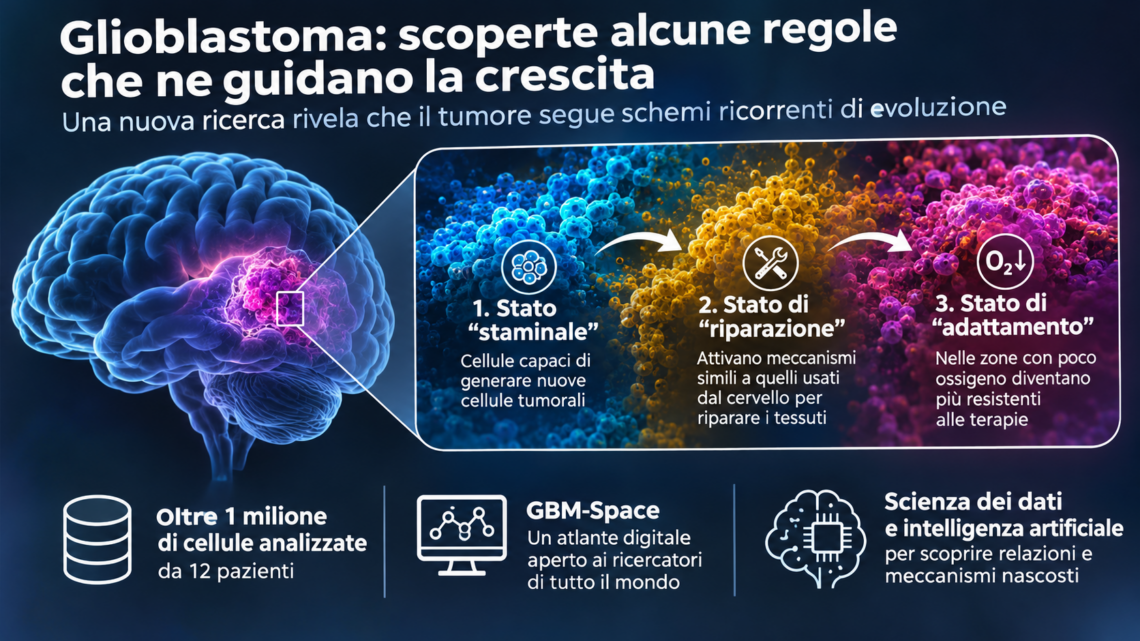
By analyzing over one million cells from 12 patients, using advanced technologies and data analysis tools, scientists identified three main biological states of tumor cells, which help explain how glioblastoma grows and manages to resist therapies.
- Stem-like state: Some cells, especially in the peripheral regions of the tumor, behave similarly to stem cells, retaining the ability to generate new tumor cells. They may contribute to tumor growth and disease recurrence.
- Repair state: Other cells exploit mechanisms normally used by the brain to repair damaged tissues, turning them into tools that promote tumor growth.
- Adaptation state: In the inner regions, where oxygen is scarce, tumor cells adapt to difficult conditions and may become particularly resistant to treatments.
These states can coexist, and cells can transition from one to another. The discovery is important because it suggests that glioblastoma behavior is not entirely unpredictable. Understanding these mechanisms and, in the future, being able to interfere with them could open up new therapeutic possibilities.
One of the most interesting outcomes is the creation of GBM-Space, a digital atlas of glioblastoma freely accessible to researchers around the world. This extraordinary resource brings together information on the characteristics, location, and behavior of over one million cells, allowing researchers to explore the tumor with an exceptional level of detail.
This is precisely the aspect I find particularly fascinating: data science and artificial intelligence can help identify hidden relationships and patterns within enormous amounts of biological information, opening up possibilities that, until just a few years ago, were difficult even to imagine.
It is an approach that I personally would have liked to explore at Elettra Sincrotrone Trieste as well, combining the three-dimensional imaging capabilities offered by synchrotron radiation with data science and artificial intelligence to study glioblastoma.
We began an interesting exploration, which we also discussed during Trieste Next 2023, and some subsequent experiences, such as the three-dimensional study of organoids at Elettra, have demonstrated the potential of these technologies. We have not yet managed to develop a specific project on glioblastoma, but I continue to believe that this path deserves to be pursued.
Of course, we are still in the field of basic research, and these findings do not represent a new treatment that is immediately available. However, gaining a better understanding of how the tumor grows, changes, and resists treatments is essential for identifying new therapeutic strategies.
This research demonstrates how important it is to bring together different areas of expertise, share data, and use the most advanced technologies to tackle such a complex disease.
The hope is that, by increasingly understanding the rules governing glioblastoma, we will finally be able to find ways to fight it more effectively.


